
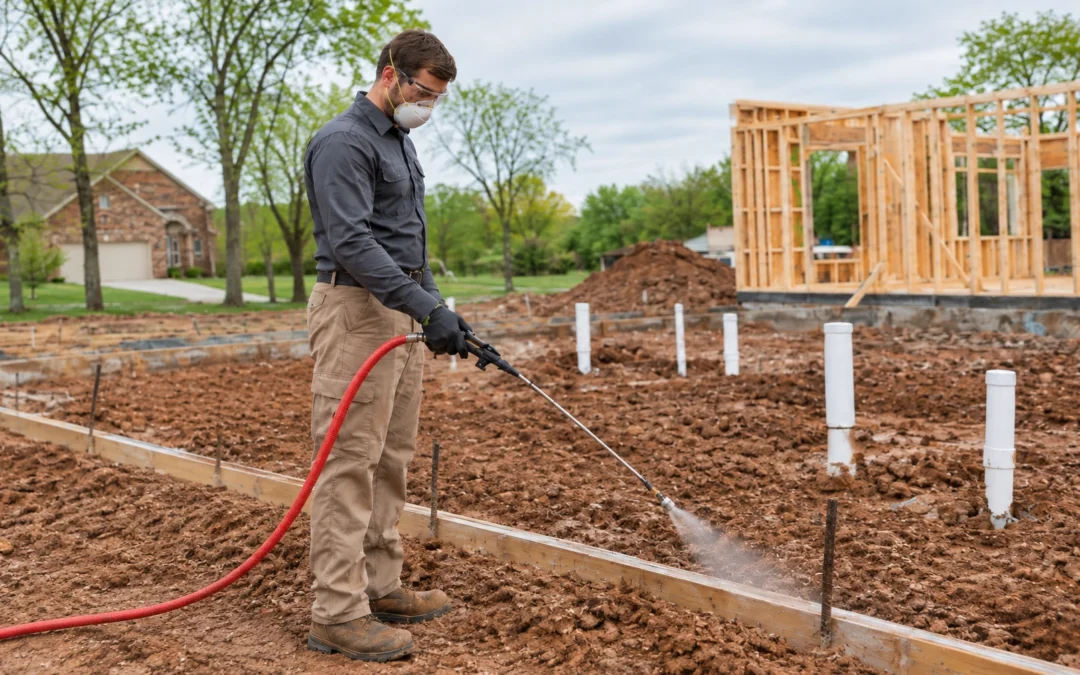
If you’re planning a new home or building project in the St. Louis area, termite pretreatment is easiest to arrange before the foundation is covered. It’s a preventive treatment applied during construction to help protect the structure from subterranean termites. Done at the right stage, it can reach soil beneath and around the future foundation that would be difficult, or costly, to access later.
That timing matters here. Eastern subterranean termites are established in Missouri, and new construction is not immune simply because the lumber and concrete are new. If you’re a builder, general contractor, developer, or custom-home buyer, a clear plan for termite protection belongs on the construction schedule, not at the end of it.
Here’s what to expect, when treatment typically happens, and what to ask before the concrete truck arrives.
What Is Termite Pretreatment?
Termite pretreatment is preventive termite protection installed during construction. For many slab-on-grade projects, a licensed applicator applies an appropriately labeled termiticide to soil beneath the planned slab and at vulnerable points around the foundation. The goal is to create a treated zone that helps deter termites from reaching wood in the finished structure.
The process may include soil beneath the slab, foundation perimeters, plumbing and utility penetrations, and attached areas such as garages or porches. Exactly what is treated depends on the building design, local requirements, the selected protection method, and the pesticide label.
This isn’t simply spraying an open patch of dirt. A useful treatment plan accounts for the full foundation layout and the sequence of construction. The coverage has to be considered before soil, forms, plumbing, and concrete make parts of the site inaccessible.
Learn more about STL Pest Control’s residential and commercial termite pre-treatment services.
Why Pre-Construction Treatment Matters in St. Louis
Termites work out of sight. Subterranean termites live in soil and can enter through small cracks or gaps where the foundation meets the ground. A slab may look solid from above while concealing vulnerable edges and penetrations below.
The University of Missouri Extension’s guide to subterranean termites describes the eastern subterranean termite as an important structural pest. In practical terms, that means builders and homeowners in the region should plan for termite risk even when the lot is newly cleared and the home has not yet been occupied.
Pre-treatment is valuable because:
- Access is best before the slab is poured. Soil beneath concrete is readily accessible during the appropriate construction window. Afterward, reaching it may require drilling or other more involved work.
- Coverage can be planned around the building layout. Treatment can address areas such as plumbing penetrations and foundation edges while they are visible and accessible.
- It can prevent avoidable schedule and repair complications. Coordinating the work ahead of concrete placement is generally simpler than discovering a missed area later and arranging corrective access.
Pre-treatment is one part of termite risk management, not a guarantee that termites can never be found. Construction details, drainage, future landscaping, soil disturbance, and ongoing inspections all matter. For a broader look at local termite activity, see our guide to subterranean termite season in St. Louis.

When Does Termite Treatment Happen During Construction?
Pre-construction termite treatment is scheduled after the relevant soil work is prepared and before the slab is poured. The exact sequence can vary by project and treatment method, so the applicator and builder should confirm the site is ready before the crew arrives.
A typical coordination sequence looks like this:
- Grading and foundation preparation: The builder completes the required excavation, grading, and soil preparation. Any areas that need to be treated should be accessible.
- Treatment beneath the planned slab: The applicator treats the specified soil or fill area in accordance with the chosen method and applicable product label.
- Attention to penetrations and transitions: Plumbing, utility entry points, bath traps, foundation edges, and other specified locations are addressed as part of the treatment plan.
- Inspection and records: The builder and applicator confirm completion and retain the service documentation before the treated areas are covered.
- Slab placement: Concrete work proceeds after the treatment and any required inspections or approvals are complete.
The key is communication. If the schedule changes, tell the applicator before the site is covered or reworked. If plumbing, backfill, or other work has already obscured treatment zones, the professional may need to reassess what can be treated effectively.

Which Areas Should the Plan Address?
There is no one layout that fits every home. The construction drawings and site conditions help determine what needs attention. Depending on the project, the treatment plan may account for:
- Soil beneath the slab or foundation area
- Foundation edges and interior foundation walls
- Plumbing and utility penetrations
- Bath traps and other openings through the slab
- Attached garages, porches, patios, or other connected sections
- Block voids or other construction details, where applicable and specified
These locations matter because a gap in a protective zone can become an easier route for termites. The goal is not to treat only the most visible open ground. It is to follow the layout and applicable label directions so that the protection is continuous in the areas the method is intended to cover.
A qualified applicator should assess the plans and conditions rather than rely on a generic square-foot estimate. For builders, providing current plans and notifying the applicator about changes, such as shifted plumbing or a revised footprint, helps avoid missed areas.
What Does the Treatment Involve?
For a soil-applied method, a licensed applicator applies a termiticide to specified soil areas using equipment suited to the site and the product label. Depending on the design and timing, the service may include horizontal treatment beneath the future slab and vertical treatment at designated foundation areas or penetrations.
The amount of finished dilution is not a universal “Missouri rate.” It is determined by the product label and the measured site conditions. As an illustration, some EPA-registered product labels describe horizontal slab treatment at 1 gallon of finished dilution per 10 square feet, with a higher amount, such as 1.5 gallons per 10 square feet, for coarse aggregate, and vertical treatment calculations based on linear feet and depth. Those are examples, not instructions for every product or project. The applicator must follow the current label for the specific product used.
Coverage and application quality matter because:
- The right areas must be included. Correct volume cannot make up for an untreated penetration or section left outside the treatment plan.
- The treatment must follow the product label. Labels specify where and how a product may be used, including application rates and restrictions.
- Construction conditions can affect access. Soil type, aggregate, moisture, grading, and construction sequence can change how treatment is properly completed.
Don’t choose a provider based on a promised gallon count alone. Ask how the applicator will calculate the treatment, what areas are included, and what documentation you’ll receive. For pesticide safety and label guidance, consult the U.S. Environmental Protection Agency’s termite information.
Is Termite Pretreatment Required in Missouri?
There isn’t a single statewide rule that automatically requires the same chemical treatment for every private construction project in Missouri. Requirements can depend on the building code adopted by the local jurisdiction, project specifications, permitting conditions, financing or insurance terms, and the protection method selected.
Some codes and local practices allow different termite-protection approaches, and chemical treatment must follow the applicable product label. Your builder or project manager should confirm requirements with the local building department and review the construction documents before scheduling work. Missouri regulates pesticide use and commercial application; the Missouri pesticide law is a starting point for state requirements.
Even when treatment is not specifically mandated for a project, a builder may include it as a preventive measure or a buyer may request it. Don’t assume that “not required” means “not worth discussing.” Ask what protection is specified and whether it meets the project’s applicable requirements.
What Builders and Homeowners Should Keep on File
Documentation helps confirm what was done and gives future owners a record to consult. After the service, ask for records that clearly identify the project and treatment. Depending on the provider and local requirements, useful documentation may include:
- Property address and service date
- Areas treated and treatment method
- Product name and EPA registration details, where applicable
- Applicator or company information
- Relevant application details required by the product label or jurisdiction
- Any warranty or service terms, including exclusions and duration
- Recommendations for follow-up inspection or care
Keep the document with your construction, permit, and warranty records. If you sell the property or need future pest control for termites, a clear record can help the next owner understand the original protection and its limitations.

Common Mistakes to Watch For
A treatment can be harder to verify or less complete when it’s rushed or poorly coordinated. Watch for these avoidable problems:
- The work is left off the schedule. If the builder assumes someone else arranged the service, the concrete may be poured before treatment occurs.
- The site is not ready. Backfill, plumbing work, or construction debris may block access to planned treatment areas.
- Only part of the layout is addressed. The slab footprint, attached garage, porch, utility penetrations, or other specified sections may be overlooked if the plans aren’t reviewed.
- No records are provided. Without documentation, it’s difficult to confirm the date, method, or scope of treatment.
- A price or volume is accepted without understanding the scope. A low number may not include all relevant areas, while a large volume alone does not prove thorough coverage.
If something changes on the job, pause and clarify the plan. It is easier to address a question while the soil and foundation areas remain accessible than after the concrete is in place.
Questions to Ask Before Construction Starts
If you’re a custom-home buyer, builder, or project manager, ask these questions early:
- Is termite pretreatment included in the plans or specifications?
- Who is responsible for scheduling the applicator?
- At what stage should the site be ready for treatment?
- Which areas are included: slab, perimeter, plumbing, garage, porch, or other penetrations?
- What treatment method and product will be used, and how will the label be followed?
- What happens if the construction schedule changes after treatment is booked?
- Will the applicator provide written documentation?
- Is there a warranty or follow-up service, and what are its terms and exclusions?
- Does the local building department require a specific inspection or record?
Get the answers in writing when possible. That gives the builder, buyer, and applicator a shared understanding before the site moves to the next phase.
How STL Pest Control Supports St. Louis Construction Projects
When you’re coordinating several trades and deadlines, you need a clear, dependable plan, not last-minute guesswork. STL Pest Control provides pre-construction termite services for residential and commercial projects in the Greater St. Louis area.
Our licensed applicators coordinate with builders and project teams, use an integrated approach, and provide treatment documentation. We’ve served the area since 1989 as a family-operated company, bringing decades of local experience to construction projects of different sizes. We can discuss timing, access, treatment scope, and the information your team needs to keep on file.
That doesn’t mean every project gets the same treatment. We review the site and requirements so the service can be planned around the construction stage and relevant product directions.

Termite Pre-Treatment FAQs
How much does termite pre-treatment cost?
The cost depends on the project’s size, foundation design, treatment method, site access, and areas included. Ask for a written estimate that explains the scope rather than comparing prices alone. The estimate should make clear whether the slab area, perimeter, penetrations, and attached sections are included.
When is termite pre-treatment done during construction?
It is generally scheduled after the relevant grading and soil preparation and before the slab is poured. Your applicator and builder should confirm the exact timing based on the construction sequence, treatment method, and local requirements.
Is termite pre-treatment required in Missouri?
Requirements vary by local jurisdiction and project. Check the adopted building code, permit conditions, plans, and any applicable financing or builder specifications. Even when it is not required, you can ask your builder whether preventive termite protection is planned.
How long does termite pre-treatment last?
There is no single duration that applies to every treatment. Longevity depends on the product and label, the application, site conditions, and whether later work disturbs the treated soil. Ask for written warranty terms and follow-up recommendations, and arrange inspections as appropriate.
Can termites still be found after a pre-construction treatment?
Yes. Pretreatment is designed to reduce risk, not provide an absolute guarantee. Changes to the site, disturbed soil, construction details, or other routes of access can affect protection. If you see signs of termite activity, arrange a professional inspection.
Plan Protection Before the Slab Is Poured
The best time to talk about termite protection is while the foundation plan and construction schedule are still taking shape. A well-coordinated service helps address the right areas while they’re accessible, provides documentation for your records, and avoids preventable confusion on pour day.
For termite pre-treatment on a St. Louis-area project, contact STL Pest Control at 314-833-6222 to discuss timing and site requirements. You can also visit our termite pre-treatment service page to learn more. We’ll help you plan the next step with clear information and a focus on peace of mind.