
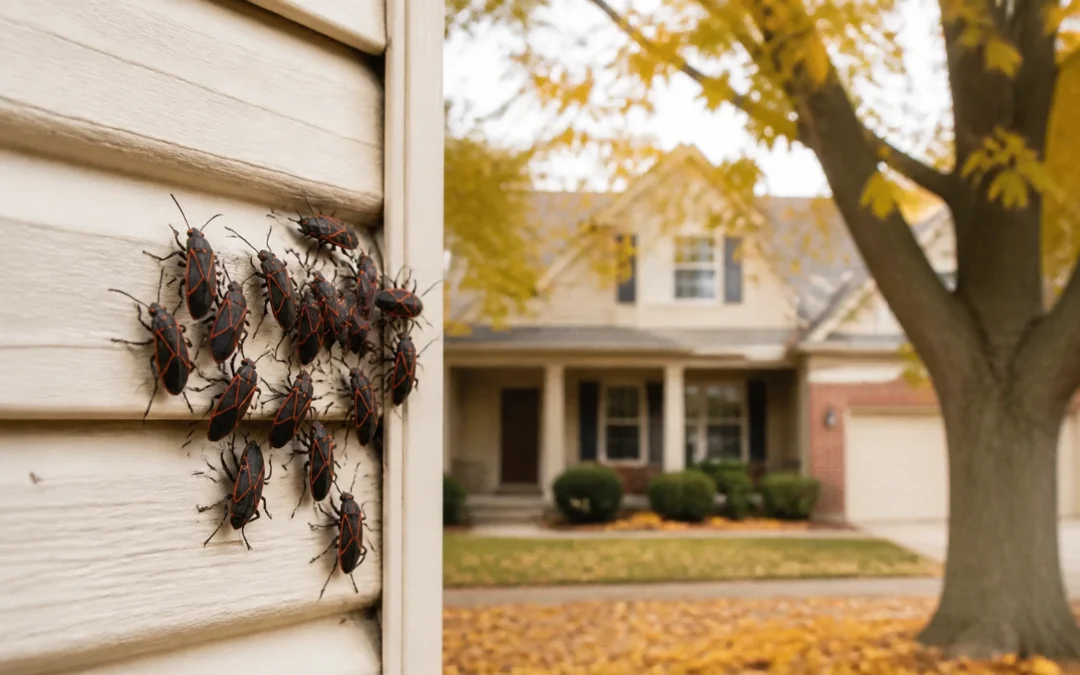
If boxelder bugs are covering the sunny side of your home each fall, you are not alone. In the St. Louis area, these black-and-red insects commonly appear in large groups from September through November, depending on temperatures and weather conditions.
The sight can be unsettling: especially when bugs begin appearing around windows, doors, and indoor light fixtures. The good news is that boxelder bugs are considered a nuisance pest, not a serious threat to your family, pets, or home.
Still, once they find a way inside, they can be difficult to remove. Here is why boxelder bugs swarm St. Louis homes, what attracts them, and how you can keep them outside.
What Do Boxelder Bugs Look Like?
Adult boxelder bugs are typically about half an inch long. They have:
- Black or dark gray bodies
- Red or orange lines along the edges of their wings
- Red markings on their backs
- A flattened, elongated shape
Young boxelder bugs, called nymphs, are smaller and often bright red with dark legs. You may see adults and nymphs together around trees, siding, windows, and exterior walls.
Boxelder bugs are sometimes confused with other red-and-black insects, including milkweed bugs and certain beetles. Correct identification matters because the best treatment depends on the pest involved.
For more information about common household pests, visit STL Pest Control’s household pest guide.

Why Do Boxelder Bugs Swarm Your Home in the Fall?
Boxelder bugs spend much of the spring and summer feeding and reproducing outdoors. As fall arrives, their behavior changes.
They begin searching for warm, protected places where they can shelter through the winter. Your home may provide exactly what they need.
1. They are attracted to warm, sunny walls
Boxelder bugs often gather on south- and west-facing walls because those surfaces receive direct afternoon sunlight. Brick, siding, concrete, and other building materials can hold warmth even after the outdoor temperature drops.
This is why you may see hundreds of bugs clustered on one side of the house while the shaded side appears unaffected.
They choose these locations because:
- Sunlight warms their bodies and helps them remain active.
- Warm walls provide a convenient resting surface.
- Cracks and gaps nearby offer access to protected overwintering areas.
2. Nearby trees provide food and breeding sites
Boxelder bugs are named for the boxelder tree, a type of maple. They are especially associated with female boxelder trees that produce seeds, although they may also be found around other maples and ash trees.
A home surrounded by mature boxelder, maple, or ash trees may be more likely to experience fall activity. The closer those trees are to the structure, the shorter the distance the bugs must travel when they begin looking for winter shelter.
The connection is straightforward:
- Trees provide food during the growing season.
- Seed-bearing trees support reproduction.
- Bugs move from the trees to nearby sun-warmed structures in the fall.
You can learn more about boxelder bugs in this STL Pest Control boxelder bug elimination guide.
3. They use tiny openings to get inside
Boxelder bugs do not need a large hole to enter your home. They can slip through gaps around:
- Window and door frames
- Siding and foundation joints
- Utility lines, pipes, and cables
- Attic and soffit vents
- Damaged screens
- Door thresholds and garage doors
Once inside, they may settle in wall voids, attics, crawl spaces, or other protected areas. During warm winter days, they can emerge indoors around windows and light fixtures.
Are Boxelder Bugs Dangerous?
No. Boxelder bugs do not bite people, sting, spread disease, or damage the structure of your home. They also do not chew through furniture, eat stored food, or reproduce inside the house.
That does not mean they are harmless from a nuisance standpoint.
Boxelder bugs can still create several problems:
- Large numbers can make windows and walls look unsightly.
- Crushing them may leave reddish stains on curtains, walls, or painted surfaces.
- They can release an unpleasant odor when disturbed or crushed.
- Indoor activity can be frustrating during winter.
- Their presence may indicate exterior entry points that other pests could use.
The most practical approach is calm, targeted prevention rather than panic. Boxelder bugs are annoying, but they are manageable.
How to Keep Boxelder Bugs Out of Your St. Louis Home
The best long-term strategy combines exclusion, yard maintenance, and targeted pest management. Spraying alone may reduce visible activity, but it will not correct the cracks and gaps that allow bugs inside.
1. Seal cracks around windows, doors, and siding
Inspect the exterior of your home before fall activity peaks. Pay special attention to sunny walls and areas where different building materials meet.
Use exterior-grade caulk to seal:
- Cracks around window frames
- Gaps around door frames
- Openings along siding seams
- Foundation cracks
- Gaps around utility penetrations
- Joints around vents and exterior fixtures
This recommendation works because:
- It blocks the direct routes boxelder bugs use to enter.
- It reduces hidden shelter areas near the home.
- It can also help keep out ants, spiders, stink bugs, and other overwintering pests.
2. Repair screens and improve weatherstripping
A damaged screen or worn door sweep can provide an easy entry point. Inspect window screens, patio doors, garage doors, attic vents, and crawl-space openings.
Replace or repair damaged screens, then install or maintain:
- Door sweeps
- Threshold seals
- Window weatherstripping
- Fine-mesh vent screens
These measures are useful because they create a continuous barrier at the areas homeowners use and open most often.
3. Keep foundation areas clean
Boxelder bugs can gather in leaf litter, weeds, fallen seeds, rocks, boards, and other debris close to the foundation.
To make the area less inviting:
- Rake leaves away from the house.
- Remove fallen seeds beneath boxelder and maple trees.
- Keep weeds and tall grass trimmed near exterior walls.
- Move firewood, boards, and stored materials away from the foundation.
- Maintain a clean, accessible strip around the structure.
A tidy perimeter helps for three reasons:
- It removes hiding places.
- It makes entry points easier to inspect.
- It supports more accurate and effective exterior treatments.
4. Vacuum indoor bugs instead of crushing them
If boxelder bugs have already entered, use a vacuum to remove them from windowsills, curtains, floors, and walls. Empty the vacuum promptly if it uses a bagless canister.
Avoid crushing large numbers of bugs because their fluids can stain surfaces and their odor may linger.
Vacuuming is the preferred indoor removal method because:
- It removes the insects without spreading them across the surface.
- It avoids the stains associated with crushing.
- It does not introduce unnecessary pesticide into your living space.

5. Evaluate nearby boxelder trees carefully
Removing a female, seed-bearing boxelder tree can reduce recurring boxelder bug activity. However, tree removal is not always necessary or appropriate.
Before removing a mature tree, consider:
- The tree’s health and location
- Its value for shade and wildlife
- Whether it is truly supporting boxelder bug reproduction
- Whether pruning or professional pest management may be enough
- Advice from a qualified arborist
Tree removal may help when a seed-bearing tree is immediately adjacent to the home and the problem returns every year. It is not a guaranteed solution when other host trees are nearby.
When Professional Boxelder Bug Control Makes Sense
DIY exclusion is a strong first step, but professional help may be worthwhile when bugs are returning in large numbers or appearing throughout the home.
At STL Pest Control, we use an Integrated Pest Management approach. That means we look beyond the visible swarm and address the conditions allowing the problem to continue.
Our service may include:
- A careful inspection to identify entry points, host trees, and areas where bugs are congregating.
- Targeted exterior treatments on siding, foundations, window frames, and other activity zones.
- Residual protection designed to remain effective after the initial application.
- Exclusion recommendations such as caulking, weatherstripping, and vent screening.
- Practical prevention guidance tailored to your home, landscaping, and seasonal pest pressure.

Our approach is designed to be effective while remaining thoughtful about your family, pets, property, and surrounding environment. We focus on treating the right areas rather than applying products broadly without a clear reason.
STL Pest Control has served the Greater St. Louis area since 1989. As a family-operated local company, we bring decades of regional experience to seasonal pest issues like boxelder bugs. You receive the resources to handle the problem and the personal service you would expect from a local team.
The Bottom Line on Boxelder Bugs in St. Louis
Boxelder bugs swarm homes in the fall because they are looking for warmth and winter shelter: not because they are trying to damage your property.
You can reduce activity by:
- Sealing cracks around windows, doors, siding, and foundations
- Repairing screens and installing door sweeps
- Cleaning leaves, seeds, and debris from the foundation
- Vacuuming indoor bugs rather than crushing them
- Evaluating nearby seed-bearing boxelder trees
- Scheduling a targeted exterior treatment when activity is heavy
If boxelder bugs are gathering around your home or finding their way indoors, STL Pest Control can help you develop a practical plan. Call 314-833-6222 to schedule a consultation and take the next step toward a more comfortable, pest-free home.