
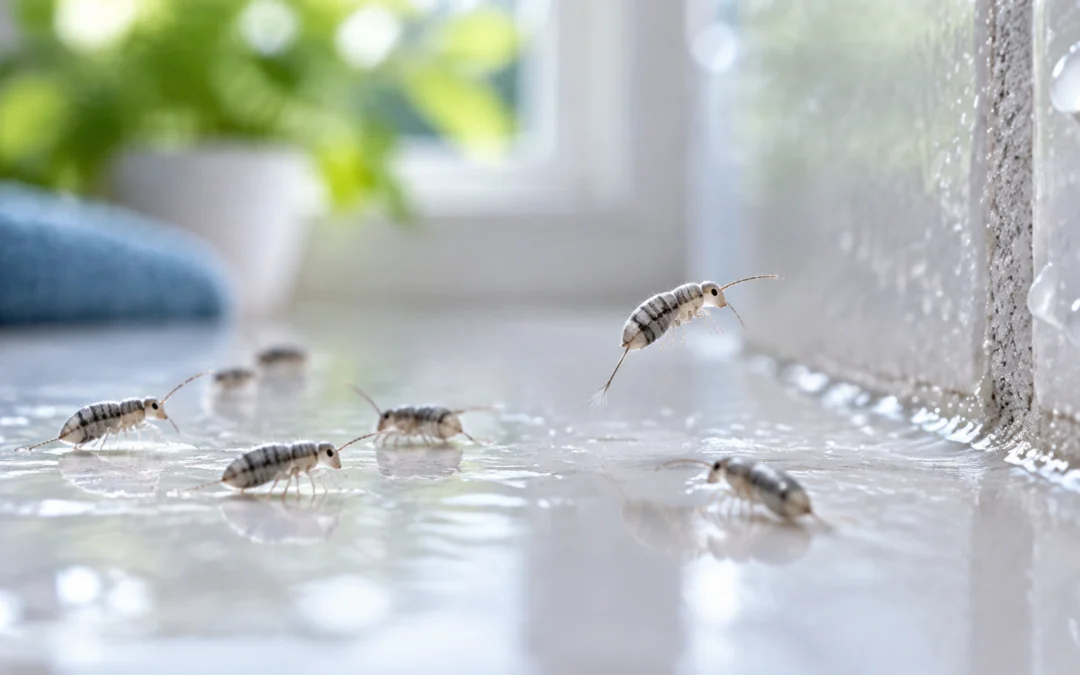
Finding tiny bugs jumping around your bathtub, basement, or windowsill can feel unsettling: especially when they look like fleas. The good news is that springtails are not biting pests. They do not attack people or pets, damage your home’s structure, or spread disease.
They are a sign of something else, though: excess moisture.
In St. Louis, humid summers, rainy spells, older brick homes, damp basements, and crawlspaces can create ideal conditions for springtails. If you are seeing large numbers of these tiny jumping pests, the most effective solution is usually not a stronger spray. It is identifying and correcting the moisture problem that allows them to survive.
STL Pest Control has served the Greater St. Louis area since 1989. Our family-operated team uses Integrated Pest Management (IPM) to address the cause of pest activity: not simply the insects you happen to see.
What Are Springtails?
Springtails are extremely small, wingless, insect-like organisms that are usually about 1/16 inch long. They may be white, gray, black, or mottled, depending on the species.
Technically, springtails belong to the group Collembola rather than the same insect orders as fleas or ants. In everyday terms, however, most homeowners recognize them as tiny jumping bugs that appear in damp areas.
They are named for a tail-like structure called a furcula.
The furcula is folded underneath the springtail’s body. When the springtail releases it, the appendage snaps against the surface and launches the animal into the air. This can propel it many times its body length.
Why this matters:
- The jumping motion is why springtails are often mistaken for fleas.
- Unlike fleas, springtails do not use their legs to leap.
- The furcula helps you understand why these pests may suddenly scatter when disturbed.
- Their jumping behavior does not mean they are aggressive or dangerous.

Springtails vs. Fleas: How to Tell the Difference
A flea concern is understandably more urgent because fleas bite people and pets. Springtails may look similar at first glance, but their habits are very different.
| Feature | Springtails | Fleas |
|---|---|---|
| Size | Usually around 1/16 inch or smaller | Small, generally dark-colored |
| Body | Soft-bodied and often pale or gray | Hard-bodied and laterally flattened |
| Jumping method | Uses a furcula beneath the abdomen | Uses enlarged hind legs |
| Food source | Mold, fungi, algae, and decaying organic matter | Blood from animals and sometimes people |
| Biting | Do not bite or sting | Can bite people and pets |
| Preferred conditions | Damp soil, moisture, mold, and organic debris | Hosts such as pets, wildlife, and people |
If you are seeing tiny jumping pests around a damp sink, basement wall, houseplant, or window with condensation: and no one is being bitten: springtails may be the more likely explanation.
Why accurate identification matters:
- Flea treatments will not correct a springtail problem.
- Springtail activity points you toward moisture control rather than pet treatment.
- Misidentification can lead to unnecessary pesticide applications.
- A professional inspection can help separate springtails from fleas, mites, booklice, or other tiny pests.
For additional identification information, see the Penn State Extension guide to springtails.
Why Springtails Appear in St. Louis Homes
Springtails need moisture to survive. They feed on mold, mildew, fungi, bacteria, algae, and decaying organic material. Outdoors, they commonly live in soil, mulch, leaf litter, compost, and damp landscaping.
St. Louis homes can offer plenty of suitable conditions, particularly during humid summers and periods of heavy rain. Older homes may also have basements, crawlspaces, masonry walls, plumbing systems, or drainage conditions that retain moisture.
Springtails may move indoors when outdoor conditions change. Extended rain can saturate their habitat, while dry weather can push them toward more humid areas. They may enter through small gaps around:
- Doors and thresholds
- Windows and screens
- Siding and foundation joints
- Utility penetrations
- Basement entry points
- Crawlspace vents
Why the St. Louis moisture connection matters:
- Humidity allows springtails to remain active and reproduce.
- Wet soil and mulch near the foundation can support large outdoor populations.
- Basement condensation can create a stable indoor habitat.
- Leaking pipes or drains may provide continuous moisture.
- Mold or mildew may be present even when it is not immediately visible.
Springtails do not prove that a home has a mold problem. However, their presence is a useful warning that moisture conditions deserve attention.
Where Springtails Gather Indoors
You may see one or two springtails, or you may find hundreds or even thousands clustered in a small area. They often gather where moisture, organic material, and limited airflow overlap.
Common locations include:
- Bathrooms and around tubs
- Sink cabinets and plumbing connections
- Floor drains
- Damp basements
- Crawlspaces
- Around windows with condensation
- Near leaky appliances
- Potted plant soil
- Laundry rooms
- Basement foundation seams
- Mulch beds near the foundation
- Areas with wet leaves or decaying debris
They may appear as tiny specks moving across tile, concrete, grout, windowsills, or the surface of standing water. When disturbed, they may jump in several directions at once, making the situation appear worse than it is.
Why large numbers can appear suddenly:
- Springtails reproduce quickly when damp conditions remain stable.
- Many may be living outdoors in mulch or soil before entering the home.
- Rain or drought can drive them toward different moisture sources.
- A small leak can support a surprisingly large population.
- Their tiny size allows them to gather in cracks, soil, and hidden organic material.

Are Springtails Harmful to People, Pets, or Your Home?
Springtails are considered nuisance pests rather than dangerous pests. They do not bite, sting, feed on blood, or intentionally attack people or animals.
They also do not tunnel into wood, weaken structural materials, or cause the type of property damage associated with termites or carpenter ants. Their presence can be alarming, but the springtails themselves are generally harmless to your family and pets.
The bigger concern is the environmental condition attracting them.
Why you should still investigate springtails:
- Persistent moisture can contribute to mold and mildew growth.
- Leaks may damage flooring, drywall, cabinetry, or insulation over time.
- Damp crawlspaces can affect indoor comfort and air quality.
- Excess humidity can encourage other moisture-loving pests.
- A recurring infestation is unlikely to stop until the underlying condition changes.
In other words, springtails are often the symptom: not the main problem.
Why Sprays Often Fail
It is tempting to spray visible springtails and expect the problem to disappear. A contact insecticide may kill some adults, but it usually does not eliminate the moisture, mold, damp soil, or organic matter supporting the population.
That is why homeowners often report that springtails return days or weeks after spraying.
Why a spray-only approach is limited:
- It targets visible springtails rather than hidden populations.
- Eggs and immature springtails may remain in damp materials.
- New springtails can enter from outdoor mulch, soil, or crawlspaces.
- Moisture allows the population to rebuild.
- Repeated spraying can expose your household to unnecessary pesticide applications.
Avoid using gasoline, bleach mixtures, or excessive indoor pesticides. These approaches can create safety concerns and may damage surfaces without solving the source of the activity.
How STL Pest Control Manages Springtails
At STL Pest Control, we use an Integrated Pest Management approach. IPM combines inspection, prevention, moisture reduction, exclusion, monitoring, and targeted treatment when appropriate.
Our goal is practical control with the least unnecessary impact on your family, pets, and home environment.
A springtail service may include the following steps:
1. Inspect the activity
We identify where springtails are gathering and look for conditions that support them.
- Plumbing leaks
- Condensation
- Damp foundation areas
- Crawlspace moisture
- Wet mulch or organic debris
- Drainage concerns
- Overwatered houseplants
- Mold or mildew indicators
2. Identify the moisture source
Reducing humidity is often the most important part of long-term control.
- A dehumidifier may be recommended for a basement.
- Ventilation may need improvement in a bathroom.
- Leaking pipes or fixtures may require repair.
- Downspouts may need to direct water farther from the foundation.
- Damp organic debris may need to be removed.
3. Recommend targeted treatment
If springtails are entering from exterior areas, a licensed technician may recommend a targeted perimeter treatment or another appropriate control method.
Treatment recommendations depend on the property, the location of the activity, and the conditions found during the inspection.
4. Provide exclusion and prevention advice
Small gaps around doors, windows, screens, and foundation openings can make it easier for springtails to enter. We can help identify practical areas to seal or improve.

How to Prevent Springtails Around Your Home
You can reduce the conditions springtails need by making moisture management part of your regular home maintenance.
Start with these steps:
- Repair leaks promptly. Check under sinks, around toilets, near water heaters, and beside appliances.
- Use a dehumidifier in damp basements. Empty and clean it regularly according to the manufacturer’s directions.
- Improve bathroom ventilation. Run the exhaust fan during showers and for a period afterward.
- Dry wet areas quickly. Do not allow standing water to remain around tubs, drains, or utility rooms.
- Allow houseplant soil to dry appropriately. Avoid keeping potting soil constantly saturated.
- Move mulch away from the foundation. A clear gap can reduce moisture and improve inspection access.
- Remove damp leaves and organic debris. Decaying material can provide food and shelter.
- Check downspouts and grading. Water should flow away from the foundation rather than collect beside it.
- Seal obvious entry points. Repair damaged screens and close gaps around doors and windows.
- Monitor condensation. Repeated moisture on windows or pipes may indicate excessive indoor humidity.

Seeing Springtails? Start With the Moisture
Springtails may look alarming, especially when hundreds appear around a bathtub, basement wall, or sink. But they are not biting pests, and they are not destroying your home.
The honest solution is to look beyond the visible bugs. Correcting moisture, reducing humidity, removing damp organic material, and improving exclusion are usually more valuable than repeated spraying.
If springtails keep returning: or if you are unsure whether you are seeing springtails, fleas, or another pest: contact STL Pest Control for a professional consultation. We have served Greater St. Louis since 1989 with licensed technicians, same-day and emergency service, and a practical IPM approach.
For help identifying the source of the activity, call 314-833-6222. We will help you take the next step toward a drier home and greater peace of mind.